
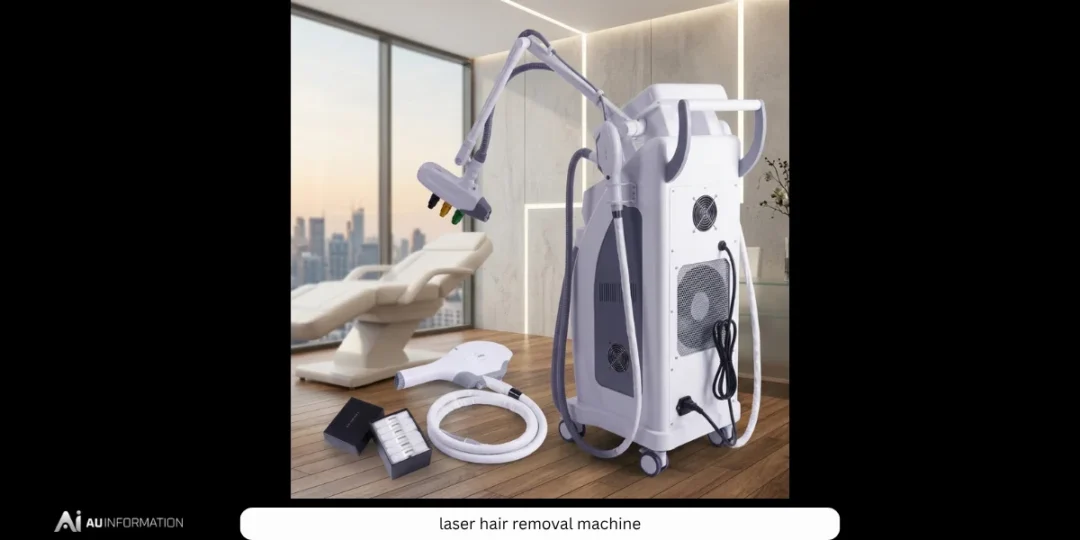
Laser hair removal has developed from a specialist cosmetic treatment into one of the most established technologies in the professional aesthetics industry. Modern laser hair removal machines can deliver long-term hair-growth reduction by directing concentrated light energy toward the pigment in the hair follicle, damaging the follicle while limiting injury to surrounding skin.
But choosing a laser machine is not simply a matter of finding the most powerful device. Wavelength, skin type, hair colour, cooling technology, treatment settings, operator training and regulatory requirements all influence the safety and effectiveness of a treatment.
For Australian clinics in particular, selecting the appropriate technology requires careful consideration because laser and intense pulsed light treatments can cause burns, pigmentation changes, scarring and eye injuries when performed incorrectly.
The three principal professional laser technologies are Alexandrite at 755 nm, Diode around 810 nm and Nd:YAG at 1064 nm. Understanding their differences is essential before investing in equipment or choosing a treatment.
How Does a Laser Hair Removal Machine Work?
Laser hair removal relies on a principle known as selective photothermolysis.
The machine produces light at a specific wavelength. The pigment melanin in the hair absorbs this energy, converting it into heat. That heat travels toward the hair follicle and can damage structures responsible for future hair growth.
The process works best when there is sufficient contrast between the hair and surrounding skin.
This is why:
- Darker, coarser hair generally responds well.
- Light blonde, grey and white hair can be difficult to treat.
- Skin pigmentation affects which wavelength can be used safely.
- Multiple sessions are normally required because hair follicles grow through different cycles.
The objective is therefore not simply to produce maximum energy. It is to deliver the appropriate energy at the appropriate wavelength for the individual client.
Alexandrite Laser: 755 nm
The Alexandrite laser operates at approximately 755 nm and has traditionally been regarded as an effective option for lighter skin types with dark hair.
Its relatively strong absorption by melanin can make it highly effective when there is adequate contrast between the hair and skin.
Advantages
- Strong melanin absorption
- Effective for dark hair
- Rapid treatment of larger areas
- Often effective on lighter skin
- Well-established professional technology
Limitations
Its strong interaction with melanin means greater caution is necessary when treating darker or recently tanned skin.
For appropriately selected clients, however, Alexandrite remains an important professional technology.
Diode Laser: Around 810 nm
Diode laser machines are currently one of the most widely used technologies in Australia’s professional laser hair-removal market.
Operating around 810 nm, diode systems provide a useful balance between hair-follicle targeting and penetration into the skin.
They are commonly used across a broad range of treatment areas and can be configured with different spot sizes, pulse durations and cooling systems.
Advantages
- Versatile professional technology
- Good penetration into the dermis
- Effective for many skin and hair combinations
- Suitable for relatively fast treatment
- Widely available commercially
For clinics treating a broad range of clients, a well-designed diode platform can be a practical choice.
However, individual treatment parameters still need to be selected according to skin type, hair characteristics and the manufacturer’s clinical guidance.
Nd:YAG Laser: 1064 nm
The Nd:YAG laser operates at 1064 nm, making it particularly valuable for clients with darker skin.
At this wavelength, absorption by epidermal melanin is lower than at shorter wavelengths. This can allow energy to reach the hair follicle while reducing—but not eliminating—the risk of unwanted epidermal heating.
Advantages
- Particularly useful for darker skin types
- Greater penetration
- Lower epidermal melanin absorption
- Important technology for diverse client populations
Limitations
Nd:YAG treatment may feel different from shorter-wavelength laser treatments, and clinical results can vary according to hair characteristics.
Correct settings and professional assessment remain essential.
Diode vs Alexandrite vs Nd:YAG
There is no universal “best” laser hair removal machine.
| Technology | Wavelength | General Strength | Common Use |
| Alexandrite | 755 nm | High melanin absorption | Lighter skin with dark hair |
| Diode | ~810 nm | Versatile balance | Broad range of clients |
| Nd:YAG | 1064 nm | Deep penetration | Darker skin types |
These descriptions are general rather than treatment prescriptions. Professional assessment should always determine the appropriate technology and settings.
Why Multi-Wavelength Machines Are Becoming Popular
One of the most significant developments in professional laser equipment is the rise of multi-wavelength platforms.
Some modern systems combine:
- 755 nm Alexandrite
- 810 nm Diode
- 1064 nm Nd:YAG
This approach gives a clinic access to different wavelengths from one platform.
The advantage is obvious for businesses serving diverse populations: rather than relying on a single wavelength, practitioners can select the appropriate technology according to the client.
However, having three wavelengths does not automatically make a machine safer or more effective. The operator must understand when and how each wavelength should be used.
Cooling Technology Matters
Cooling is an important component of modern laser hair-removal systems.
Laser energy produces heat. Effective cooling can help protect the epidermis and improve treatment comfort.
Common cooling approaches include:
- Contact cooling
- Sapphire cooling
- Cryogen cooling
- Air cooling
- Integrated cooling systems
A machine with impressive headline specifications but poor thermal management may be less attractive for a busy professional clinic.
When evaluating equipment, examine the complete cooling system, not merely whether the manufacturer uses the word “cooling” in its marketing.
Professional Machines vs Home Devices
Consumers will encounter both professional laser machines and home hair-removal devices.
These should not be treated as equivalent.
Professional systems are generally designed for trained operators and can deliver substantially different energy levels and treatment capabilities. Home devices commonly use lower-energy technologies, and many are actually IPL rather than laser.
What Is IPL?
IPL stands for intense pulsed light.
Unlike a conventional laser, which produces light concentrated around a particular wavelength, IPL produces a broader spectrum of light.
Therefore:
IPL is not technically a laser.
The two technologies may both be marketed for hair reduction, but their underlying physics and equipment design are different.
How Much Does a Professional Laser Machine Cost?
Professional laser hair-removal equipment varies dramatically in price.
In Australia, professional systems can cost approximately A$15,000 to more than A$180,000, depending on factors such as:
- Number of wavelengths
- Laser technology
- Cooling system
- Handpiece design
- Spot size
- Pulse characteristics
- Manufacturer
- Warranty and service support
- Regulatory and compliance requirements
A more expensive machine is not necessarily the right machine for every clinic.
A smaller clinic might achieve better business value from a reliable single-wavelength platform than from an expensive multi-platform system whose additional capabilities are rarely required.
What Should a Clinic Consider Before Buying?
A professional buyer should evaluate the machine as a complete business investment.
1. Client Demographics
Consider the skin tones and hair characteristics commonly encountered in the clinic.
2. Wavelength
Choose technology appropriate for the population rather than selecting equipment solely because it has the highest advertised power.
3. Cooling
Evaluate actual thermal-management performance and treatment comfort.
4. Manufacturer Support
Service availability is crucial. A machine that remains out of operation for weeks can represent a significant business cost.
5. Training
Ensure practitioners receive appropriate training in operation, contraindications, parameter selection and safety procedures.
6. Compliance
Australian requirements for cosmetic laser and IPL services differ between states and territories. Confirm the rules applicable to the location where the equipment will be used.
Common Buying Mistakes
One of the biggest mistakes is buying based on marketing claims rather than clinical suitability.
Other common errors include:
- Choosing maximum power instead of appropriate parameters
- Ignoring skin-type considerations
- Failing to investigate cooling
- Buying equipment without adequate local service
- Assuming IPL and laser are interchangeable
- Neglecting operator training
- Failing to check Australian regulatory requirements
- Selecting equipment without considering treatment volume
The best investment is rarely the machine with the longest specification sheet. It is the machine that can be operated safely, consistently and profitably for the clinic’s actual clientele.
Safety Should Come Before Speed
Laser hair removal is a medical-adjacent cosmetic procedure involving concentrated optical energy.
Australian radiation-safety authorities have warned that incorrectly performed laser and IPL treatments can result in serious injuries, including burns, scarring, pigmentation changes and eye damage.
Professional clinics should therefore place safety at the centre of every treatment.
Important measures include:
- Appropriate protective eyewear
- Proper client assessment
- Skin and hair evaluation
- Correct treatment parameters
- Appropriate patch testing where indicated
- Equipment maintenance
- Operator training
- Clear treatment documentation
- Compliance with relevant regulations
Eye protection deserves particular attention because laser energy can cause severe ocular injury.
The Future of Laser Hair Removal Machines
The industry is moving toward systems that are more versatile, comfortable and data-driven.
Future developments are likely to involve:
- Multi-wavelength platforms
- Improved cooling
- More sophisticated treatment interfaces
- Better skin-type assessment
- Automated parameter recommendations
- Greater treatment-speed efficiency
- Improved ergonomic handpieces
Artificial intelligence and imaging technology could eventually play a larger role in treatment planning by helping practitioners assess skin and hair characteristics before selecting settings.
Nevertheless, technology will not eliminate the importance of professional judgment.
Conclusion
The best laser hair removal machine in 2026 is not necessarily the most expensive or powerful device. It is the system whose wavelength, cooling technology, operating characteristics and support infrastructure match the clinic’s clients and professional requirements.
Alexandrite 755 nm remains a valuable option for appropriate lighter skin types, 810 nm diode technology offers broad versatility, and 1064 nm Nd:YAG is particularly important when treating darker skin types.
For clinics serving diverse populations, multi-wavelength systems combining 755 nm, 810 nm and 1064 nm can offer considerable flexibility.
But equipment selection should always come after consideration of safety, training, regulation and clinical suitability. In professional aesthetics, the smartest investment is not simply the machine that promises the most impressive results—it is the technology that allows trained practitioners to deliver appropriate, controlled and safe treatments consistently.




No Comments