
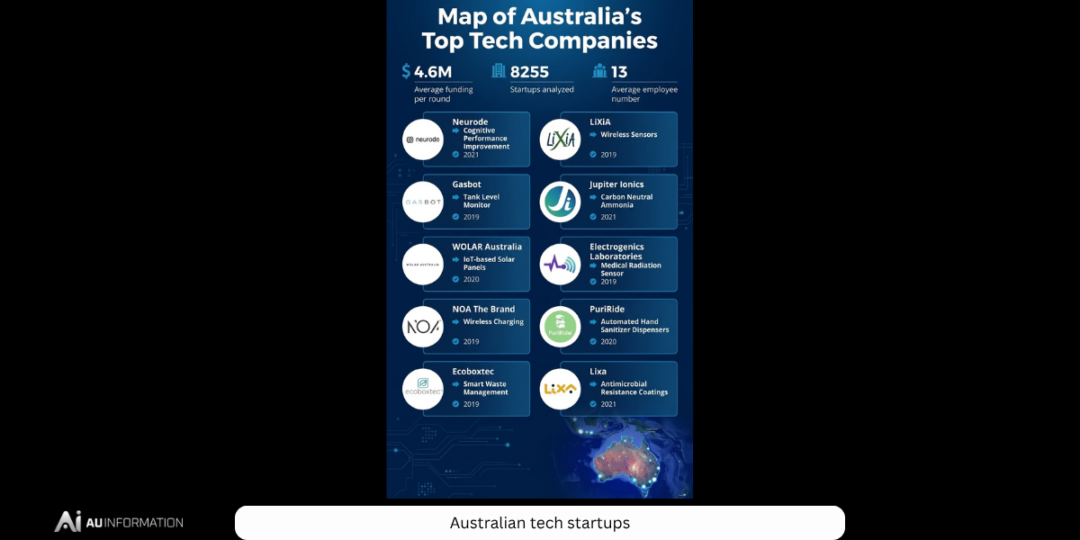
Australia’s technology startup sector has entered an important new phase. Once viewed primarily as a market that produced successful software companies for local customers, Australia is increasingly developing businesses capable of competing internationally in artificial intelligence, fintech, health tech, cybersecurity, climate technology, and deep tech.
That momentum is reflected in Australia’s position as the world’s ninth-ranked startup ecosystem in 2026, according to StartupBlink. The country also has seven startups that have reached unicorn status, meaning valuations of more than US$1 billion. Canva remains the most recognizable example, but a growing group of Australian-founded businesses is now building substantial international operations.
The investment environment is also strengthening. In August 2026, Blackbird Ventures announced that it had raised A$1.05 billion, the largest venture capital fund ever raised in Australia and New Zealand, providing further evidence that international investors see significant potential in the region.
For founders and investors, the central question is no longer whether Australia can produce successful startups. It is whether the next generation can turn Australian innovation into globally dominant technology companies.
Why Australian Tech Startups Are Growing
Australia possesses several characteristics that make it an increasingly attractive environment for technology entrepreneurs.
The country has a highly educated workforce, strong universities, sophisticated financial institutions and a mature business environment. Major cities such as Sydney, Melbourne and Brisbane also has established technology communities, while smaller ecosystems in Adelaide, Perth and Hobart are producing increasingly specialized companies.
Another advantage is Australia’s position in the Asia-Pacific region. Australian startups can develop products locally while targeting much larger markets across Asia, North America, and Europe.
The strongest startups increasingly follow a global-first strategy from the beginning.
Australia’s Growing Startup Reputation
StartupBlink’s 2026 data places Australia ninth globally and first within Australia and Oceania. Its ranking considers factors including startup activity, investment, business environment, and ecosystem infrastructure.
This is important because startup ecosystems depend heavily on networks. Successful founders create experienced employees who later become founders themselves, while investors, accelerators and technology companies create the infrastructure required for new businesses to emerge.
Australia is therefore benefiting from the success of an earlier generation of companies such as Canva, Atlassian, Afterpay, and others.
Australian AI Startups Are Leading the New Wave
Artificial intelligence has become one of the most important areas of Australian startup investment.
The country’s AI ecosystem spans healthcare, enterprise software, infrastructure, financial services, robotics and automation. Rather than simply building generic AI applications, many Australian companies are applying artificial intelligence to specialized industries where they possess significant domain knowledge.
Heidi Health
One of the strongest examples is Heidi Health, a Melbourne-based health technology company using artificial intelligence to reduce administrative workloads for clinicians.
Heidi won Deloitte’s 2025 Technology Fast 50, recording an extraordinary 15,323% three-year revenue growth rate. That figure demonstrates how quickly demand for practical AI solutions can develop when technology addresses a genuine operational problem.
The company’s approach is particularly instructive for entrepreneurs because its value proposition is not simply “AI-powered healthcare.” Instead, the technology is aimed at a specific problem: reducing administrative work and allowing healthcare professionals to spend more time on patient care.
Relevance AI
Relevance AI is another Australian company attracting attention in the rapidly developing AI-agent market. Its technology focuses on enabling businesses to build and deploy AI agents that can perform operational tasks.
This reflects a broader shift in artificial intelligence. The market is moving beyond chatbots toward systems capable of completing multi-step workflows.
Harrison.ai
Healthcare AI is also represented by Harrison.ai, which develops artificial intelligence applications designed to support medical professionals.
Healthcare is particularly suitable for specialised AI because the industry generates enormous quantities of structured information while facing persistent workforce and administrative pressures.
The opportunity, however, comes with substantial regulatory and safety responsibilities. Healthtech founders cannot treat AI accuracy, privacy and clinical oversight as secondary concerns.
Fintech Remains an Australian Strength
Before artificial intelligence became the dominant investment story, fintech was one of Australia’s strongest startup categories.
Australian companies have built significant businesses around payments, banking infrastructure, financial management and cross-border transactions.
Airwallex
Airwallex is perhaps the strongest modern example. Founded in Melbourne, the financial technology company has developed a global platform for payments and financial operations.
In June 2026, Airwallex announced financing at an US$11 billion valuation, demonstrating how an Australian-founded company can evolve into a major international financial technology business.
Its trajectory also illustrates an important lesson for Australian founders: the domestic market can be a launchpad, but global scale usually requires international ambition.
Airwallex has also become an investor in Australia’s next generation of entrepreneurs.
In April 2026, it launched Latitude 37, committing A$1 million annually to support more than 10 early-stage Australian AI startups. Each selected company receives A$100,000 in equity-free funding, alongside access to Airwallex’s network and international immersion opportunities.
Healthtech Is Becoming a Major Growth Engine
Australia’s healthcare system provides startups with a large collection of complex problems to solve.
These include:
- Administrative inefficiency
- Medical imaging
- Digital patient management
- Clinical decision support
- Mental health services
- Remote healthcare
- Healthcare workforce shortages
The success of companies such as Heidi Health and Harrison.ai suggests that Australia’s healthcare expertise can combine effectively with software and artificial intelligence.
For investors, healthtech also offers an important distinction from consumer technology. Successful healthcare companies may develop long-term enterprise relationships because their products become embedded within professional workflows.
Deep Tech Is the Next Strategic Frontier
Perhaps the most important long-term development is the growth of Australian deep-tech startups.
Deep tech differs from conventional software startups because it often involves fundamental scientific or engineering breakthroughs.
Australia has particular strengths in:
- Quantum computing
- Semiconductors
- Space technology
- Advanced manufacturing
- Robotics
- Biotechnology
- Artificial intelligence infrastructure
- New energy technologies
These companies typically require more capital and longer development periods than conventional software startups.
However, successful deep-tech businesses can create defensible intellectual property and address enormous global markets.
That makes the sector increasingly attractive to investors looking beyond the immediate AI boom.
Climate Technology and Sustainability
Climate technology is another area where Australian conditions create natural opportunities.
Australia’s enormous renewable-energy resources, mining industry, agricultural sector and exposure to climate-related challenges provide fertile ground for innovation.
Startups are working on areas such as:
- Renewable-energy infrastructure
- Battery technology
- Carbon management
- Agricultural technology
- Energy efficiency
- Water management
- Sustainable materials
Firmus Technologies provides a useful example of the growth potential in this category. The company ranked third in Deloitte’s 2025 Tech Fast 50 after achieving 2,249% three-year revenue growth, and it also won the program’s Climate and Sustainability category.
Australia’s Startup Unicorns
Australia’s unicorn companies demonstrate that local startups can achieve global scale.
Canva is the country’s standout technology success story, but the broader unicorn group illustrates the diversity of Australia’s startup economy.
Other major Australian technology companies have emerged across:
- Financial technology
- Software
- Digital marketplaces
- Cybersecurity
- Gaming
- Enterprise technology
The important lesson is that Australia’s strongest companies are not confined to one sector.
They are solving problems in industries where technology can create substantial economic value.
What Makes a Successful Australian Startup?
Rapid funding growth alone does not guarantee success.
From an experienced business perspective, the strongest startups usually share several characteristics.
Solve a Real Problem
Technology should solve a problem customers genuinely experience.
A sophisticated product with no urgent customer need will struggle regardless of how advanced its technology may be.
Build for International Markets
Australia’s domestic market is relatively small compared with the United States, Europe and major Asian markets.
Founders should therefore consider international expansion early.
Protect Intellectual Property
This is particularly important for deep-tech, biotechnology and AI companies.
Strong intellectual property can create a competitive advantage that is much harder for competitors to reproduce.
Maintain Capital Discipline
The recent venture-capital boom should not encourage founders to spend aggressively without evidence of product-market fit.
Blackbird’s new A$1.05 billion fund is significant, but the firm’s own messaging emphasises that its early-stage strategy remains focused on backing founders at the beginning of their journeys.
Common Mistakes Australian Startups Should Avoid
Despite the positive environment, Australian founders face several recurring challenges.
One mistake is treating Australia as the final market rather than the starting point. A company can dominate locally while remaining too small to achieve meaningful global scale.
Another is confusing fundraising with business success. A large funding round can provide resources, but sustainable revenue, customer retention and operational discipline ultimately determine whether a startup becomes a durable company.
A third mistake is adopting AI simply because it is fashionable. Investors are becoming more selective as the technology matures. Blackbird’s 2026 fund announcement, for example, noted greater caution around some AI investments as obvious opportunities become crowded.
Expert Tips for Founders in 2026
For entrepreneurs considering an Australian startup, several principles remain particularly valuable.
Start with the customer, not the technology. Identify a painful problem before developing an elaborate solution.
Think globally from day one. Understand how the product could eventually work in multiple markets.
Use AI where it creates measurable value. Automation should reduce costs, improve productivity or create better outcomes.
Build strong networks. Investors, mentors, industry partners and experienced employees can be as important as initial capital.
Measure genuine traction. Revenue growth, retention, customer acquisition and usage are more meaningful than vanity metrics.
Plan for regulation early. This is especially important for healthtech, fintech, cybersecurity and deep-tech businesses.
The Future of Australian Tech Startups
The next decade could be particularly important for Australia’s technology economy.
AI is likely to remain a major source of startup formation, but the strongest opportunities may increasingly come from the combination of AI with specialised industries.
Healthcare, finance, agriculture, defence, energy and advanced manufacturing all offer enormous opportunities for companies that can combine software with genuine industry expertise.
Deep tech could become equally important over the longer term. Quantum computing, space technology, biotechnology and advanced manufacturing require patience, capital and scientific expertise, but they could produce some of Australia’s most strategically important companies.
The investment environment is also becoming more sophisticated. Blackbird’s record A$1.05 billion raise, Airwallex’s Latitude 37 programme and continued international investment indicate that Australian founders have access to a stronger capital and support network than previous generations.
Conclusion
Australian tech startups are entering 2026 with stronger global credibility, deeper investment networks and a broader range of opportunities than ever before. Australia now ranks ninth globally for its startup ecosystem, while companies such as Canva and Airwallex demonstrate that Australian-founded businesses can compete at international scale.
AI is currently driving much of the excitement, with companies such as Heidi Health demonstrating how rapidly specialised technology businesses can grow. Fintech remains a powerful Australian strength, while healthtech, cybersecurity, climate technology and deep tech are creating additional opportunities.
The real opportunity, however, is not simply producing more startups. It is producing companies capable of becoming enduring global businesses.
With record venture capital, increasingly experienced founders and growing international interest, Australia has an opportunity to turn its reputation for innovation into a much larger technology economy. The startups emerging today may ultimately determine whether Australia remains a successful technology market or becomes a major global technology exporter.




No Comments