
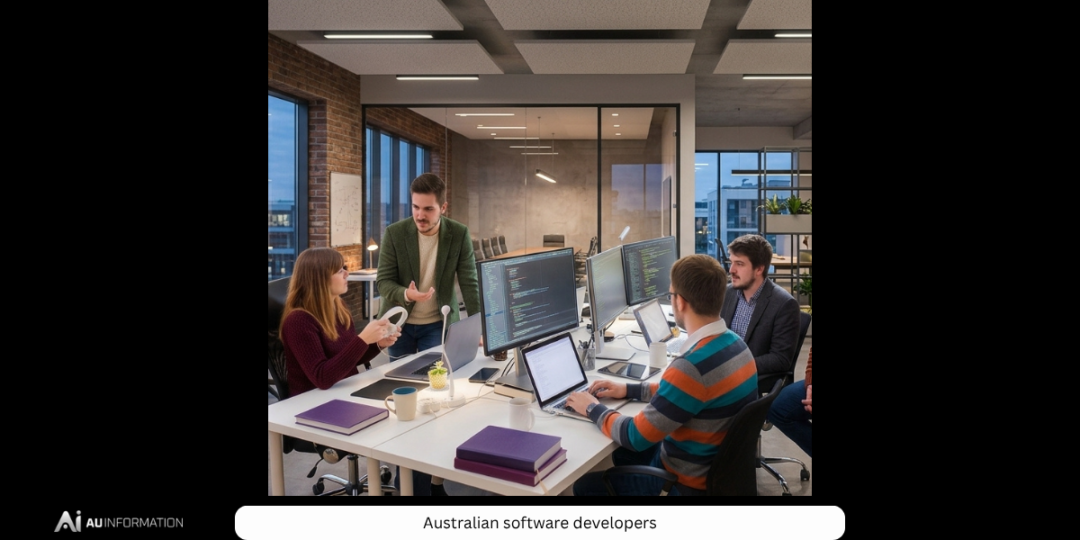
Australian software developers are at the centre of one of the country’s most important technology transformations. From Sydney fintech companies and Melbourne startups to healthtech businesses, government agencies and cybersecurity firms, software developers build the digital systems that increasingly support Australia’s economy.
The profession is also changing rapidly. Traditional programming remains important, but developers are now expected to work with cloud platforms, artificial intelligence, automation, cybersecurity and data-intensive applications. AI-assisted coding is particularly significant because it is changing how software is designed, tested and maintained.
According to Jobs and Skills Australia, Australia has approximately 94,900 software engineers, with New South Wales accounting for about 42.2% of the workforce and Victoria around 31.7%. This concentration makes Sydney and Melbourne the country’s two major centres for software-development talent.
For aspiring developers, the opportunity is substantial—but the definition of a good developer is changing.
What Do Australian Software Developers Do?
Software developers design, build, test and maintain digital products and systems.
Their work can include everything from a mobile application used by consumers to the infrastructure supporting a major financial institution.
Common responsibilities include:
- Designing software architecture
- Writing and reviewing code
- Developing web and mobile applications
- Testing and debugging software
- Managing databases
- Building APIs
- Deploying cloud applications
- Improving application security
- Automating repetitive processes
- Maintaining existing systems
- Collaborating with product and design teams
The exact responsibilities depend heavily on the organisation and the developer’s level of experience.
A junior developer might spend much of their time implementing features and fixing bugs, while a senior software engineer may be responsible for architecture, technical strategy, system reliability and mentoring other developers.
How Large Is Australia’s Software Engineering Workforce?
Software development represents a substantial professional occupation within Australia’s technology sector.
Jobs and Skills Australia records around 94,900 software engineers nationally under its newer occupational classification. The broader software-and-applications programmer category encompasses an even larger group of technology professionals.
The geographic distribution is particularly important.
New South Wales
NSW accounts for approximately 42.2% of Australia’s software engineers, making it the country’s largest software-development market.
Sydney benefits from its concentration of:
- Banks and financial institutions
- Fintech companies
- Technology startups
- Global technology companies
- Government organisations
- Professional-services firms
Victoria
Victoria accounts for approximately 31.7% of software engineers, with Melbourne serving as a major technology and startup centre.
Melbourne’s ecosystem is particularly strong in fintech, healthtech, enterprise software, AI, cybersecurity and digital technology.
Together, Sydney and Melbourne account for the overwhelming majority of Australia’s software-engineering talent.
Software Developer Salaries in Australia
Software development remains a relatively well-paid professional field.
Published Australian employment data places median full-time earnings for software and applications programmers at around A$2,537 per week, equivalent to approximately A$132,000 per year before tax when annualised.
However, salary varies considerably according to experience, location, specialisation and employer.
A developer’s earning potential can be influenced by:
- Years of professional experience
- Technical specialisation
- Leadership responsibilities
- Industry
- Cloud and infrastructure expertise
- Cybersecurity knowledge
- AI and machine-learning capability
- Company size
- Ability to work on complex systems
Senior engineers with scarce technical expertise can command substantially higher compensation, particularly in financial services, cloud infrastructure, cybersecurity and AI-focused organisations.
It is important not to treat a national median as a guaranteed salary. Entry-level developers can earn considerably less, while experienced specialists and engineering leaders may earn considerably more.
The Most Valuable Programming Skills in Australia
The Australian software market continues to require a broad technical skill set.
Some of the most relevant technologies include:
Python
Python remains particularly valuable because it is used in web development, automation, data science, artificial intelligence and machine learning.
JavaScript and TypeScript
These technologies remain central to modern web development, particularly alongside frameworks such as React.
React
React is widely used for developing modern web interfaces and remains an important skill for full-stack and front-end developers.
AWS and Cloud Computing
Cloud expertise has become increasingly important as organisations migrate applications and infrastructure away from traditional on-premises systems.
AWS, Microsoft Azure and Google Cloud are particularly relevant across the Australian market.
SQL and Data Engineering
Almost every significant software platform interacts with data. Understanding databases, SQL and data architecture therefore remains highly valuable.
Cybersecurity
Security is no longer solely the responsibility of dedicated cybersecurity teams. Developers increasingly need to understand secure coding, authentication, access control, encryption and vulnerability management.
AI Is Changing Software Development
The biggest change affecting Australian software developers may be artificial intelligence.
AI coding assistants can generate code, explain unfamiliar programming concepts, suggest solutions, create tests and help developers identify bugs.
This does not necessarily mean that developers are becoming unnecessary.
Instead, the value of human expertise is shifting.
A developer who previously spent hours writing routine code may now use AI to produce an initial implementation and spend more time reviewing the result, testing edge cases and designing the overall system.
This creates a new requirement: developers must be able to evaluate AI-generated code rather than blindly accept it.
AI can produce code that appears correct while containing security vulnerabilities, inefficient logic or subtle errors.
The strongest developers of the future will therefore combine:
- Programming fundamentals
- System design
- AI-tool proficiency
- Code review
- Testing
- Security awareness
- Problem-solving
- Communication
Full-Stack Development Remains Valuable
Full-stack developers can work across both front-end and back-end systems.
A typical full-stack developer might work with:
Front end: React, TypeScript, HTML and CSS
Back end: Python, Java, Node.js or another server-side technology
Database: PostgreSQL, MySQL or another database system
Infrastructure: AWS, Azure or Google Cloud
Development workflow: Git, CI/CD and automated testing
This broad understanding can be particularly useful at startups, where engineers frequently need to work across multiple parts of a product.
However, being a full-stack developer does not mean knowing every technology. Strong fundamentals remain more important than collecting a long list of programming languages.
Sydney vs Melbourne for Software Developers
Both cities provide strong opportunities, but their ecosystems have different characteristics.
Sydney has particularly strong connections with finance, fintech, enterprise technology and global corporations.
Melbourne has a notable presence in startups, healthtech, AI, games, research and enterprise software.
For developers choosing between the two cities, the better option depends on the industry and employer rather than simply the number of available jobs.
Other Australian cities—including Brisbane, Canberra, Perth and Adelaide—also provide technology opportunities, particularly in government, defence, mining technology, cybersecurity and specialised engineering.
Remote Work and the Australian Developer Market
Remote and hybrid work have changed how developers approach employment.
Software is particularly suitable for distributed work because many development activities can be performed online.
However, remote work does not eliminate the importance of communication.
A successful remote developer must be able to:
- Communicate clearly in writing
- Document technical decisions
- Collaborate across time zones
- Manage priorities independently
- Participate effectively in code reviews
- Understand business requirements
In many organisations, hybrid employment has become a practical middle ground between traditional office work and fully remote teams.
How to Become a Software Developer in Australia
A university degree can be useful, but it is not the only route into software development.
A practical pathway can include:
Step 1: Learn Programming Fundamentals
Start with one language rather than attempting to learn five simultaneously.
Python or JavaScript can provide accessible entry points.
Step 2: Build Real Projects
Create applications that demonstrate what you can actually build.
For example:
- A budgeting application
- A task-management platform
- An e-commerce prototype
- A weather application
- An AI-powered productivity tool
Step 3: Learn Git and GitHub
Version control is a fundamental part of professional software development.
Step 4: Understand Databases and APIs
Modern applications rarely operate independently. Developers need to understand how systems communicate and store information.
Step 5: Learn Cloud Fundamentals
Basic knowledge of cloud infrastructure can significantly improve employability.
Step 6: Learn to Use AI Responsibly
Use AI tools as development assistants, not replacements for technical understanding.
Common Mistakes New Developers Make
One of the most common mistakes is focusing too heavily on programming languages.
A developer who knows ten languages but cannot design a reliable application is less valuable than someone who understands one or two languages deeply.
Other common mistakes include:
- Copying AI-generated code without understanding it
- Ignoring cybersecurity
- Avoiding testing
- Building tutorial projects without creating original work
- Neglecting communication skills
- Focusing only on syntax rather than problem-solving
- Failing to understand how software reaches production
Employers generally want evidence that candidates can solve real problems.
The Future of Australian Software Developers
The future is unlikely to be defined by humans competing directly against AI.
Instead, development teams will increasingly combine human engineers with AI-powered tools.
Routine coding tasks may become faster and increasingly automated. At the same time, demand could grow for professionals capable of handling complex architecture, cybersecurity, AI integration, data systems and highly regulated applications.
This means software development is likely to become more strategic.
The developer of the future may spend less time manually producing repetitive code and more time asking:
What should we build? How should it work? Is it secure? Can it scale? Can we trust the result?
Those are engineering questions—not simply coding questions.
Conclusion
Australian software developers remain an essential part of the country’s technology economy, with approximately 94,900 software engineers working across industries ranging from fintech and healthcare to cybersecurity, cloud computing and artificial intelligence.
Sydney and Melbourne continue to dominate Australia’s software talent market, while opportunities are also expanding in other technology centres.
The most important development, however, is the transformation of the profession itself.
AI-assisted programming is making routine development faster, while cloud computing, cybersecurity, data engineering and complex system architecture are increasing the need for highly capable technical professionals.
For people entering the industry, the lesson is straightforward: do not train simply to write code. Train to solve problems.
Developers who combine strong fundamentals with AI literacy, security awareness, cloud expertise and sound engineering judgment will be best positioned to build the next generation of Australian technology.




No Comments